Your Data May Trigger the Next Assessment: How FBR’s CRM is redefining Tax Scrutiny
For decades, tax risk was viewed primarily through the lens of legislation. Businesses focused on interpreting the law, calculating the correct liability and defending the position adopted in their returns.
That remains essential, but it is no longer the complete picture.
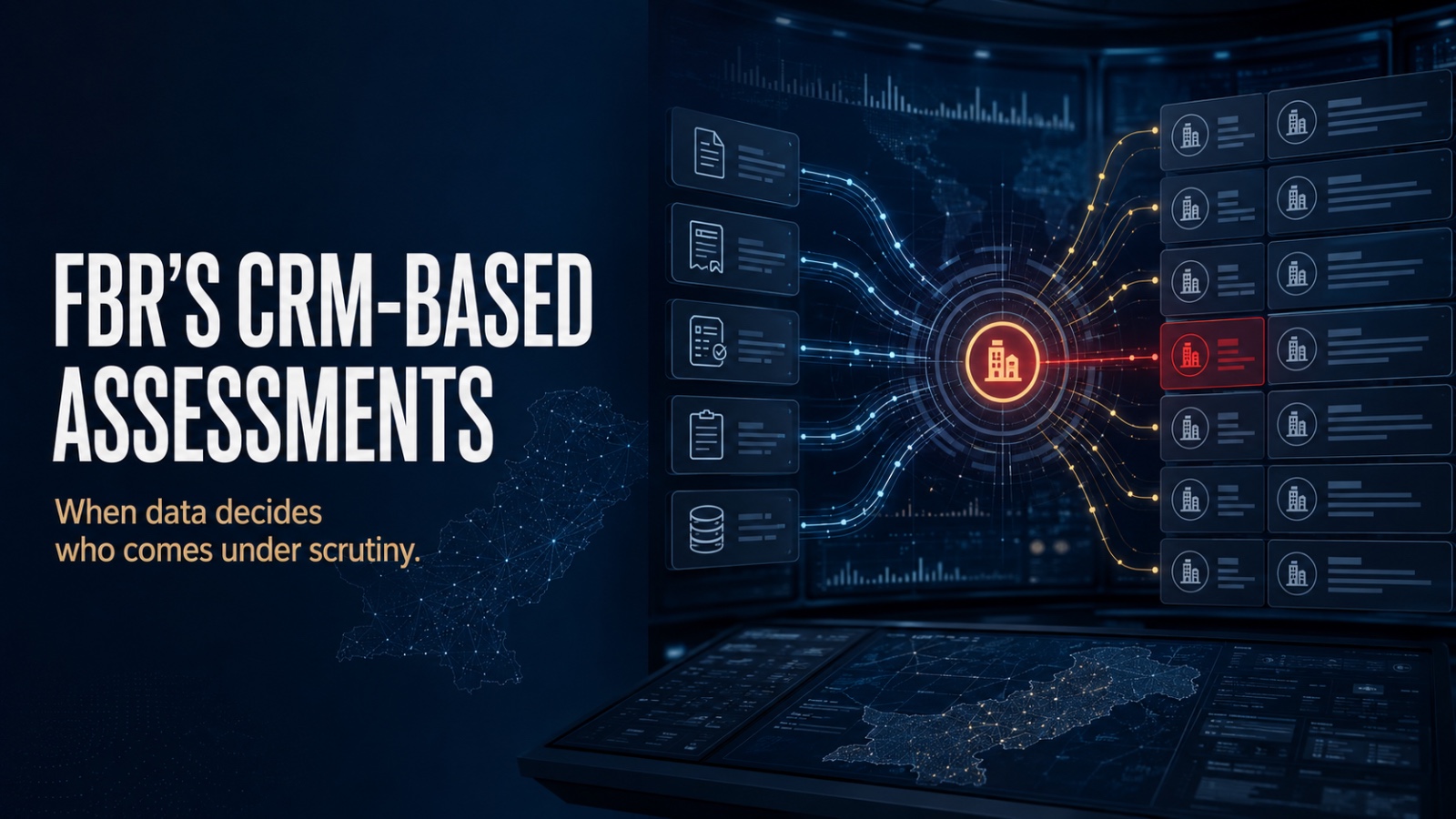
FBR’s introduction of mandatory Compliance Risk Management (CRM)-based selection for assessment proceedings signals a deeper change in Pakistan’s tax administration. The significance of CRM lies not merely in how a case is selected, but in what may increasingly influence that selection: the data already available to the tax authority.
FBR does not presently have routine access to the complete books of account of every business. Its visibility is largely constructed from the information submitted through income tax returns, sales tax returns, withholding statements, electronic invoices, customs records and third-party reporting.
Individually, these declarations provide only a partial view of a business. Collectively, however, they can reveal inconsistencies.
Turnover declared for income tax may not align with sales reported for sales tax. Withholding statements may not correspond with the expenses appearing in financial statements. Electronic invoices may reflect transaction values or classifications that differ from periodic declarations. Imports, inventory movements and reported sales may not follow a commercially coherent pattern.
None of these differences necessarily establishes a tax default. There may be entirely legitimate accounting, legal or commercial explanations. But in a risk-based system, an unexplained mismatch does not need to prove non-compliance, it only needs to make the taxpayer appear unusual enough to warrant scrutiny.
This changes the order in which tax risk emerges.
Previously, a tax officer might examine a taxpayer’s records and then identify an issue under the law. Increasingly, technology may first identify an inconsistency in the data, leading to selection, after which the taxpayer must explain the accounting treatment, documentation and legal position behind it.
The Distance Between FBR and the Books Is Narrowing
The present CRM framework should be understood as part of a continuing digital evolution rather than an isolated administrative measure.
Electronic invoicing has already moved FBR closer to transaction-level information. As digital reporting expands and accounting systems become more standardized, it is reasonable to expect tax-risk systems to become progressively more connected with the records from which tax declarations originate.
The next stage may involve prescribed digital ledgers, system-based extraction of accounting information or integration between CRM and enterprise accounting records. Instead of comparing only the final figures declared in returns, future risk models may be capable of analyzing transaction patterns, ledger movements, unusual journal entries and differences between books and tax filings.
The practical consequence is significant: the accounting record itself may increasingly become part of the tax position.
Businesses that wait for such access to become mandatory will be addressing years of accumulated data weaknesses under regulatory pressure. Incomplete vendor records, inconsistent classifications, unsupported adjustments and unreconciled balances cannot always be corrected through a year-end exercise.
Tax Risk Is Becoming an Enterprise Issue
This development also challenges the traditional view that taxation belongs exclusively to the tax department.
The quality of a tax declaration depends upon information generated across the business. Procurement determines how vendors are onboarded. Sales teams influence customer and transaction classifications. Human resources generates payroll information. Supply-chain functions maintain inventory and movement records. Finance translates these activities into accounting entries, while technology determines how the information is captured and retained.
A weakness anywhere in this chain can ultimately appear as a tax mismatch.
Tax governance must therefore extend beyond filing deadlines. Management needs confidence that material declarations reconcile with the books, differences between reporting platforms can be explained, transaction classifications are consistently applied and supporting documents can be retrieved when required.
The objective is not simply to file an accurate return. It is to create an evidentiary chain connecting the commercial transaction, accounting treatment, tax declaration and legal position.
From Tax Defence to Tax Readiness
The emerging environment requires businesses to look beyond periodic tax compliance and examine whether the data underlying their declarations is complete, consistent and capable of being substantiated.
This is where we step in. Through a comprehensive Tax Data Integrity check, businesses can become enhance tax readiness. By bringing together technical tax knowledge with an understanding of accounting systems, documentation and business processes, our team can assist management in reconciling regulatory declarations with the underlying books and identifying inconsistencies before they develop into more significant tax exposures.
Where differences arise, the focus should extend beyond correcting the reported figure. It is equally important to determine whether the difference results from a tax exposure, timing issue, accounting treatment, data error or weakness in the underlying process.
This may involve reviewing information reported through income tax, sales tax, withholding and electronic-invoicing systems; tracing material figures to the accounting records; assessing supporting documentation; and helping management strengthen the controls and responsibilities surrounding tax data.
The objective is not simply to prepare businesses for a particular notice or assessment. It is to develop a more sustainable state of tax readiness; one in which material declarations can be reconciled, differences can be explained, and tax positions can be supported through reliable records and contemporaneous documentation.
As tax administration becomes increasingly data-driven, it is important for a business to understand not only what the law requires, but also whether their data, systems and processes are prepared to demonstrate compliance.
In the emerging tax environment, legislation will continue to determine what a business owes. But data will increasingly determine what the tax authority sees, what it questions and whom it selects.
Businesses must be prepared for both.

By,
Mohammed Kamil Gohar - FCA, BFP, ACA (England and Wales)
Partner (Riaz Ahmad, Saqib, Gohar & Co.)
September 03, 2026.